Posts

Chord City & Friends & Me

Image
This blog has been conspicuously dormant for a while.  I wasn't kidding when I called it "potentially ill-fated."  Last time I posted anything was last summer.  A lot has happened since then in my musical life.  And I'd like to tell you about it.  If you're interested, that is.  If not, why are you reading this? Still here?  Okay then.  Let's start at a church fundraiser in 1989.  Here's a grainy still from a video shot at that event. Chord City, circa 1989 There is a little boy in the lower left-hand corner.  His head is circled for your convenience.  He is watching his father (center, face obscured by microphone) play guitar, along with his uncle (drums) and their long-time friends.  Members of this group have played together for years, long before this little boy was born.  This is the first time he's seen them play together publicly.  He'd been to a practice or two, but this is the real deal.  There i...

Portrait of an Effective Song: "Mama" by Genesis

I didn't like "Mama" by Genesis when I first heard it.*  The grinding synthetic heartbeat that drives the song is unsettling, even anxiety-producing.  Bump-bump, CRASH! Bump-bump, CRASH!  Bump-bump, CRASH! Bump-bump, CRASH!  It feels like a sci-fi Telltale Heart , a relentless pounding that hurtles toward insanity. I now consider "Mama" to be a brilliant and emotionally effective song.  By emotionally effective, I mean that the song evocatively portrays the feelings contained therein, both instrumentally and lyrically.  Keyboardist Tony Banks used some sort of unearthly synthesizer sound for the main melody, a kind of eerie whale call echoing into darkness.  It resembles sounds you might hear in an old haunted house film, but manages to avoid sounding silly.  Underneath the main melody is a subtle, but percussive and frenetic rapid-fire organ following along in time with the heartbeat.  At other times, a more subtle synth pad fills in the ...

Musicians I Know: Chris Paquette

Image
Chris Paquette is my non-biological brother and one of my longest-lasting friendships.  He and I were born six days apart. His dad is the mutual friend who introduced my parents to each other.  Chris and I grew up together.  Chris started playing alto saxophone in grade school, but found his real musical calling in percussion in his teenage years.  He has been keeping the beat ever since.  An accomplished musician, Chris has played with acts covering a broad spectrum of genres and styles.  Although he moved to Chicago nearly two decades ago, we have kept in touch and jammed whenever we've had a moment.  As an amateur, it's a real privilege for me to get to play with a "real musician" from time to time.  I was honored when Chris agreed to play percussion at my wedding during a short Eager Anxiety set (my folk-rock duo). As a player, Chris possesses that magical combination of speed and consistency that makes him a deeply talented professional ...

Top 10 Lists Are Hard, So I Made a Top 20 List - It Was Still Hard

If you like a lot of music and a lot of musicians, making a Top 10 list is hard.  But it can also be fun.  But then hard.  But then kind of fun again.  But then you remember the things you left out and think "oh man, I should've put that in...but then what would I take off to make room for it?"  As with many of life's tasks - fun or not - you must, at some point, cut yourself off and say, "ummmm...good enough (?)" and move on. This sentiment deserves some context.  For the last few years, The Current (89.3 FM) , a Twin Cities-based public radio station (Minneapolis/Saint Paul, Minnesota, U.S.A., for any international readers), has done "The 893 Essential [something-something]" lists as defined by its listeners.  Listeners go to the website and submit their own Top 10 list.  After station personnel tally the votes, the list is broadcast in the order of votes received for each entry.  They air the selected songs during their periodic fund dri...

"What Is That Thing?"

Image
Image from Wikimedia Commons This is a pedal steel guitar.  It's a strange looking and wondrous instrument.  It is mainly associated with country music or country-ish folk.  If you're not familiar with its sound, I think it could best be described as the love child of a guitar and a theremin. I don't know how to play it.  But I like it. This little essay isn't about the steel guitar itself, however, but rather how one man used it in a unique and brilliant way.  That man is Pee Wee Charles (and he's on LinkedIn ).  His real name is Ed Ringwald, but his stage name is way funnier, so I'm going with it. Pee Wee Charles played pedal steel guitar for Gordon Lightfoot from 1975-1989.  Yes, that Gordon Lightfoot.  He's done quite a few other things before and since then, but I'm focusing on the Lightfoot period of his career.  This period interests me because Charles didn't use the pedal steel in a traditional country manner, but rather mo...

This Old Guitar

Image
There are three main reasons that I play guitar.  Two of them are Gordon Lightfoot and The Moody Blues, respectively.  The most important reason is my dad.  As a child, I remember hearing and watching him play his 12-string guitar.  When he and his college friends/bandmates (including my uncle) reunited for a church fundraiser in 1989, I was mesmerized.  In family videos of that show, you can see this little kid in a bowl cut and a "Moos Brothers" sweatshirt (cow-based pun on the Blues Brothers) wandering around in front of the stage, staring up at dad & co.  Guess who. My dad has been a skilled finger-picker as long as I can remember.  He could really make that 12-string jangle as he played old folk tunes.  When I was 10, I decided that I wanted to start guitar lessons.  On the night of my first guitar lesson, my dad let me try out his guitar before we left.  It was enormous and I could barely get my arms around the body.  ...

One of My Favorite Albums Turns 50 This Year

Image
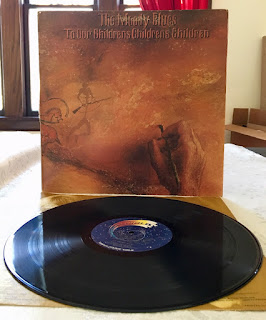
Sometimes I am still startled by the rocket blast.  I've listened to this album hundreds of times.  I know it's coming.  And yet I still sometimes jump at the sudden white-noise cacophony.  An organ cries briefly through the roar, then a wall-of-sound vocal chant emerges, reaching a crescendo before the guitars and bass fade in to take over.  It's so delightfully late '60s. So begins "To Our Children's Children's Children" by the Moody Blues, one of my favorite albums.  From time to time, I will put it on, turn out all the lights, put aside any potential distractions (except maybe a glass of wine), and just let it wash over me.  I sing a number of tracks from the album to my toddler as lullabies. December of this year marks the 50th anniversary of "Children's Children"; the Moody Blues produced two albums in 1969 and this one is the second.*  Two albums in one year is a tall order, but the band and their producer, inspired...